Every server. One window.
Ferry is a fast, beautiful SFTP, FTP and S3 client. Several servers side by side, drag-and-drop between any of them, a terminal on the same connection — and passwords that never leave your machine.
Built for people who live on servers.
Everything you'd expect from a serious file-transfer client, designed to feel at home on a Mac — and just as good on Windows.
Up to four servers side by side
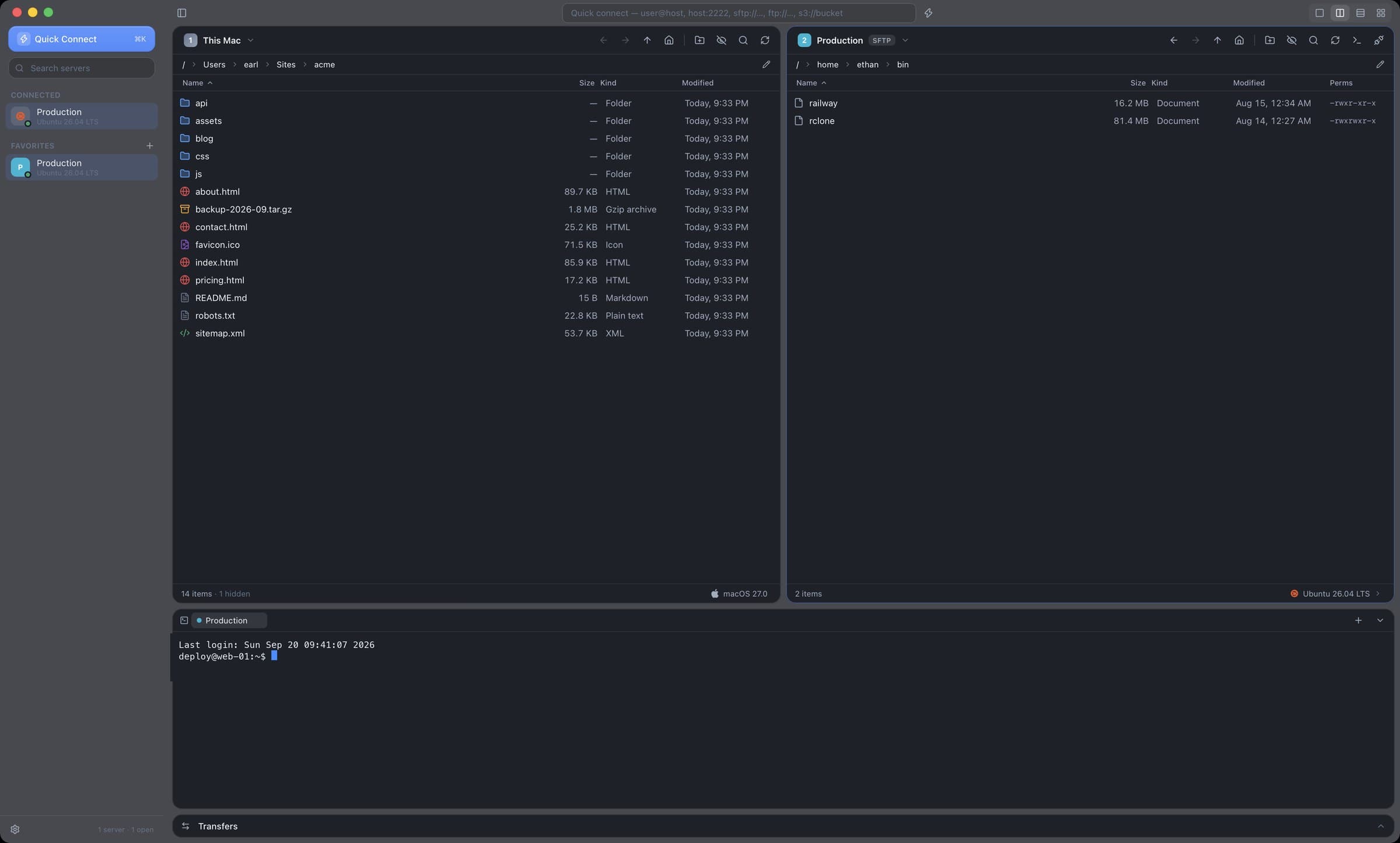
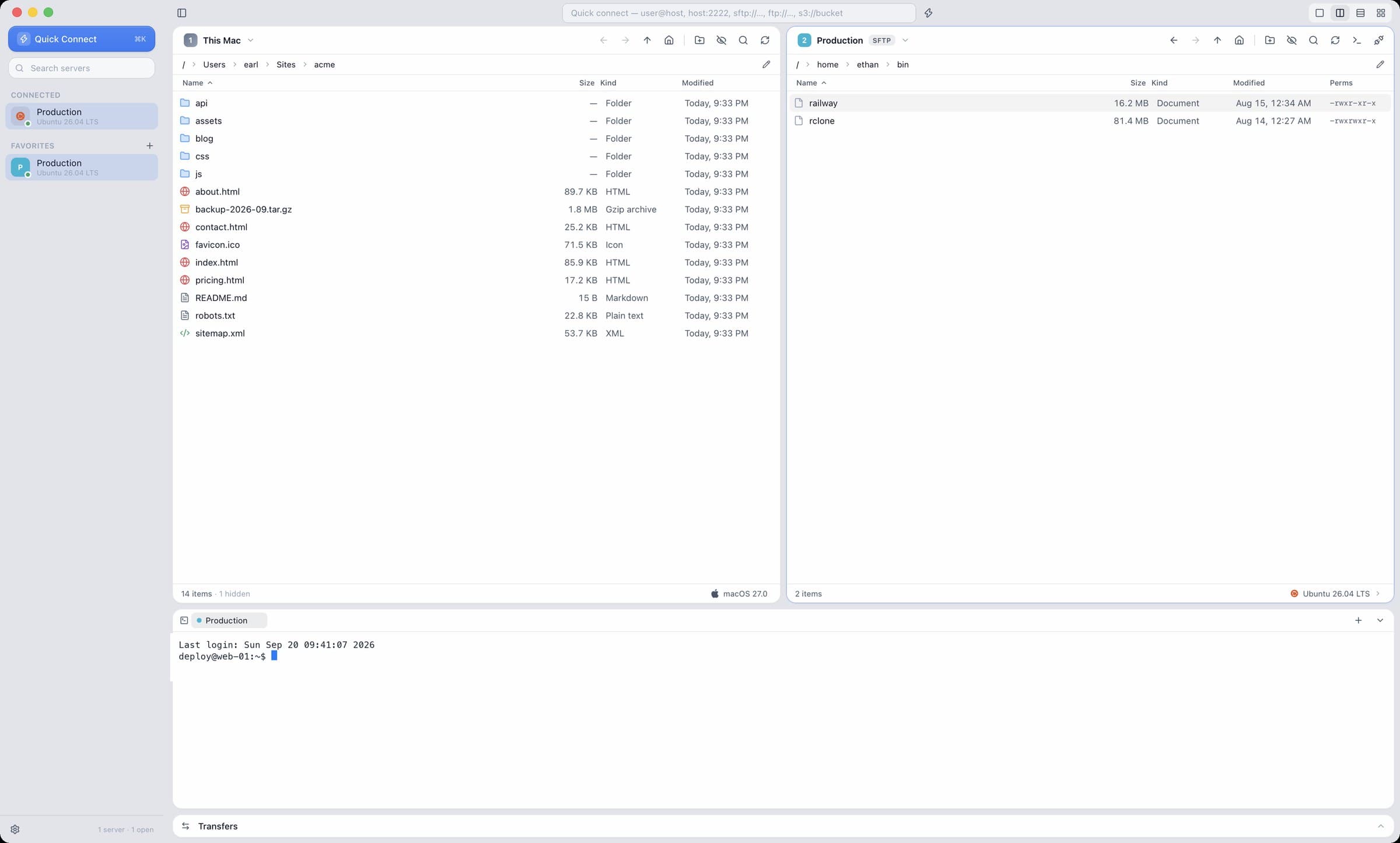
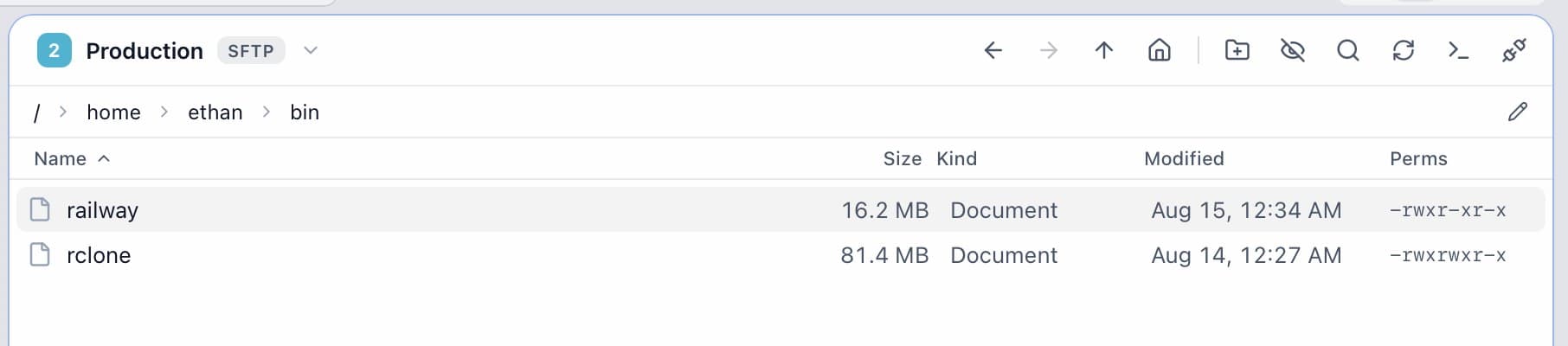
Split the window into 1, 2, 3 or 4 resizable panes. Each pane shows any connection — or your own machine — with the server's name, colour and OS on it, so you always know which one you're in.
Drag anything anywhere
Local → server, server → local, server → server. Drop a selection on a folder, or fan one selection out to several servers at once with Copy to…. Conflicts ask; timestamps are kept.
A terminal on the same connection
Open a shell on any SFTP server without logging in again — same tunnel, same host key. Untar an upload or fix permissions without leaving the window.
It knows what it's talking to
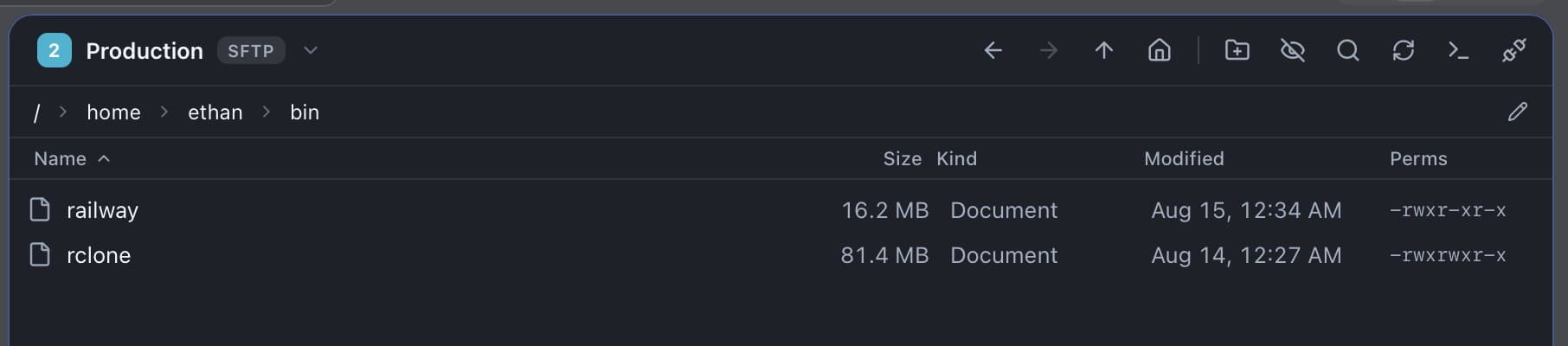
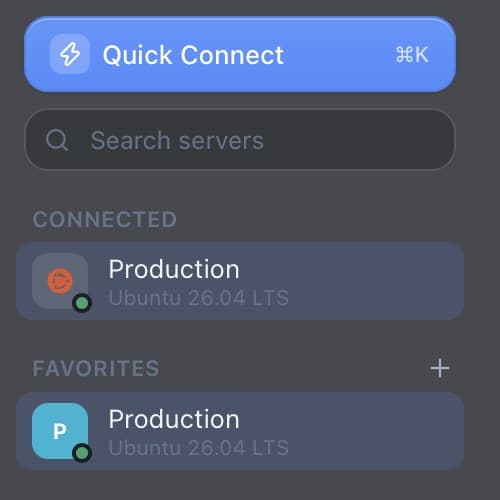
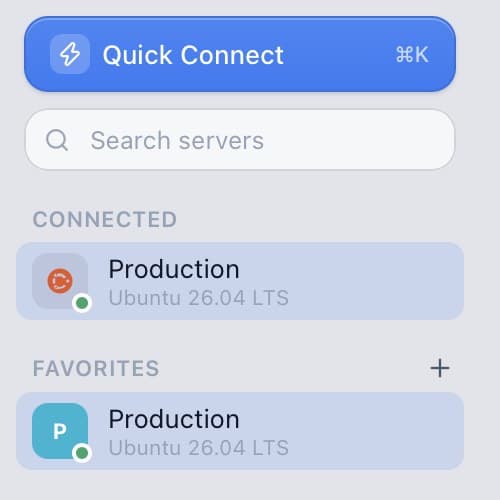
Ubuntu, Debian, macOS, Windows Server, FreeBSD, Amazon S3, Cloudflare R2, MinIO… Ferry identifies the other end and shows it with the right icon in the status bar.
Favorites, groups, quick connect
Nested groups, colours, Quick Connect that saves nothing, and an address bar that takes user@host or a URL. Import from FileZilla, Cyberduck, WinSCP or ~/.ssh/config.
Permissions and the small stuff
A proper rwx editor with octal and recursive apply, hidden files per pane, rename, Quick Look for remote files, and a queue that shows speed, ETA and what's waiting.
Drop into a shell. Same connection, zero setup.
Press ⌘T on any SFTP server and you're at a prompt over the tunnel you already have. No second login, no second host-key dance, no juggling a separate terminal app. Untar what you just uploaded, tail a log, restart the thing.




It knows Ubuntu from FreeBSD. And R2 from S3.
The moment you connect, Ferry asks the other end what it is — distribution, version, kernel, architecture — and puts the answer, with the right logo, in the status bar and the sidebar. Four panes open? You'll never confuse staging with production again.
Browse your Railway services like a folder.
Railway exposes every service over SSH. Register your key once, run railway ssh config, and Ferry imports the services straight from your SSH config — Railway badge, terminal, and transfers to and from the container's volume included.
Light, dark, or whatever your Mac is doing.
Sidebar vibrancy like Finder, glass menus and controls, your accent colour — and full-window Liquid Glass on macOS 26 if you're into that. It follows the system, or you pick.
Your passwords stay on your computer.
Site passwords live in an AES-256-GCM vault. Its key is the single item Ferry keeps in the macOS Keychain or Windows Credential Manager — created by Ferry, so you're never nagged. Exports can carry passwords sealed with a passphrase you choose (Argon2id). Updates are signed; Ferry refuses anything that doesn't verify.
- Host keys verified against ~/.ssh/known_hostsNew keys are shown as SHA-256 fingerprints; changed keys are flagged loudly.
- Password, key file, certificate or agentOpenSSH keys and certificates, ssh-agent, 1Password and Secretive all work.
- No telemetry, no accountFerry never phones home except to check for updates — and that carries nothing about you.
- Signed & notarizedDeveloper ID signed with the hardened runtime on macOS.
Questions, answered.
Is Ferry free?+
Yes, while it's in beta. There's no account, no sign-in and no telemetry.
Which protocols?+
SFTP (password, key file, OpenSSH certificate or ssh-agent), FTP, FTPS explicit and implicit, and S3 — Amazon S3 plus anything S3-compatible such as MinIO, Cloudflare R2, Backblaze B2, Wasabi and DigitalOcean Spaces.
Where are my passwords stored?+
In an AES-256-GCM encrypted vault on your computer. The vault key is the one and only item Ferry keeps in the macOS Keychain or Windows Credential Manager, and it's created by Ferry itself — so no keychain prompts.
Can I move to a new computer?+
Export your servers as a single .ferry file — with passwords if you like, sealed with a passphrase — and import it on the other side.
Does it update itself?+
Yes. Ferry checks for signed updates on launch and every few hours, and installs on restart. You can turn that off in Settings.
Windows?+
Yes — same app, same features, Mica window material on Windows 11. Grab the installer on the download page.
Ready when you are.
Download Ferry and connect to your first server in under a minute. Free while in beta, signed and notarized, no account.
Something missing? Tell Earl Balai, or see what's coming.